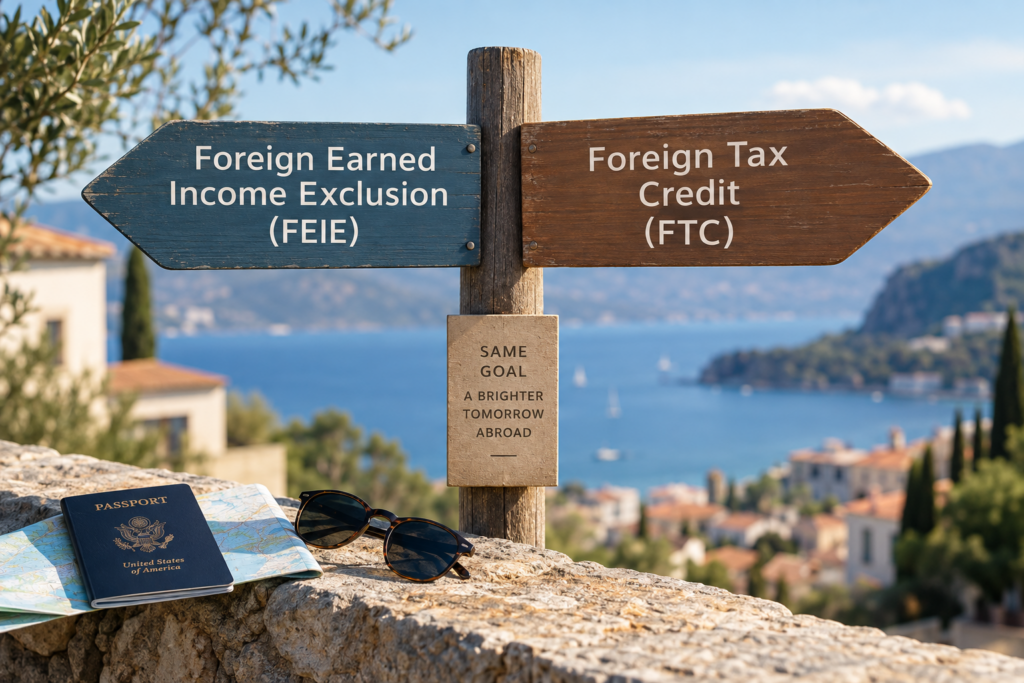
Americans living abroad have two powerful tools available to reduce U.S. tax on their foreign income: the Foreign Earned Income Exclusion and the Foreign Tax Credit.
The Foreign Earned Income Exclusion (FEIE) lets qualifying expats remove a limited amount of foreign earned income from U.S. federal income tax. The Foreign Tax Credit (FTC), by contrast, gives you a credit for qualifying foreign income taxes you pay, subject to IRS limits.
For many expats, either approach can reduce U.S. income tax to zero. However, the better choice depends on where you live, how much foreign tax you pay, the type and amount of income you receive, your family circumstances and your longer-term plans.
At a glance: FEIE vs. Foreign Tax Credit
| FEIE | Foreign Tax Credit | |
| What it does | Excludes qualifying foreign earned income from U.S. income tax | Credits qualifying foreign income taxes against U.S. tax |
| 2026 limit | Up to $132,900 per qualifying person | Depends on qualifying foreign taxes and the FTC limitation |
| Income covered | Foreign earned income | Several categories of foreign-source income |
| Special residence test | Yes | No FEIE-style residence or physical presence test |
| Often suits | Expats in low- or no-tax countries | Expats in higher-tax countries |
| Unused amount | No carryforward | Generally 1-year carryback and 10-year carryforward |
| Main form | Form 2555 | Form 1116 in most cases |
For the 2026 tax year, the IRS lets each qualifying taxpayer exclude up to $132,900 of foreign earned income under the FEIE.
What is the Foreign Earned Income Exclusion?
The Foreign Earned Income Exclusion allows qualifying U.S. taxpayers living abroad to exclude foreign earned income from federal income tax, up to the annual limit.
Foreign earned income generally includes wages, salaries and income from personal services you perform abroad. Investment income such as interest, dividends and capital gains doesn’t count as foreign earned income for FEIE purposes.
To qualify, you need a foreign tax home and must meet either the bona fide residence test or the physical presence test. Under the bona fide residence test, you generally need to establish residence in a foreign country for an uninterrupted period that includes an entire tax year. The physical presence test instead focuses on the number of days you spend in foreign countries, specifically, if you spend at least 330 full days in a foreign country or countries during any 12 consecutive months.
You claim the exclusion on Form 2555 and attach it to your U.S. tax return. You still report the income on your return – claiming the FEIE doesn’t mean you leave that income off your tax forms.
The annual ceiling also matters. If you earn more than $132,900 in 2026, the FEIE alone can’t shelter all of that income.
What is the Foreign Tax Credit?
The Foreign Tax Credit takes a different approach. Instead of excluding income, it gives you a credit for qualifying income taxes you pay to a foreign country.
Suppose you live in the UK and pay UK income tax on your salary. The U.S. also taxes citizens on worldwide income, so that salary can enter your U.S. tax calculation as well. The FTC can offset U.S. income tax attributable to foreign-source income, subject to the FTC limitation.
In most cases, you calculate the credit on Form 1116.
The IRS generally limits your credit to the smaller of your qualifying foreign tax or the U.S. tax attributable to the relevant foreign-source income. It also requires separate calculations for different income categories in many situations.
One major advantage comes from unused credits. When qualifying foreign taxes exceed the amount you can use in the current year, you can generally carry the excess back one year and forward for up to 10 years. Exceptions apply to certain categories of income.
FEIE vs. FTC: the key differences
The core distinction comes down to exclusion versus credit.
The FEIE removes qualifying earned income from U.S. taxable income up to an annual ceiling. The FTC keeps the foreign-source income in your U.S. tax calculation but uses qualifying foreign income tax to offset U.S. tax.
That difference creates several practical consequences.
The FEIE only covers earned income, while the FTC can apply to qualifying foreign taxes on several types of foreign-source income. The FEIE also requires you to meet specific overseas eligibility tests, while the FTC doesn’t require the same physical presence or bona fide residence tests.
The FTC can also preserve value for future years through carryovers. The FEIE doesn’t offer an equivalent carryforward for any unused portion of its annual limit.
When does the FEIE make more sense?
The FEIE often deserves consideration when you live in a country that charges little or no personal income tax.
For example, an American employee living in the UAE may pay little or no local income tax on salary. With little foreign income tax available to claim as a credit, the FTC may offer limited relief. If that taxpayer meets the FEIE eligibility requirements, excluding qualifying salary can produce a better U.S. tax result.
The FEIE may also work well when:
- Most of your income comes from salary or other qualifying earned income and falls within the annual exclusion limit.
- You qualify comfortably under the bona fide residence or physical presence test, so eligibility doesn’t create uncertainty.
- Your host country charges substantially less income tax than the U.S., leaving too little foreign tax to offset your potential U.S. liability.
The FEIE doesn’t automatically eliminate every U.S. tax obligation. Self-employed taxpayers for example must still pay U.S. self-employment tax (social security taxes) on net earnings, unless a Social Security totalization agreement provides that the income is covered by the other country’s system.
When does the Foreign Tax Credit make more sense?
The FTC often proves attractive in countries where local income tax rates equal or exceed U.S. rates.
An American living in the UK, France or Germany, for example, may pay enough qualifying foreign income tax to offset most or all U.S. income tax on the same income. In that situation, the FTC can eliminate U.S. income tax without excluding the underlying earnings.
The FTC may also offer important longer-term advantages. If your foreign tax exceeds your current FTC limit, qualifying excess credits can move into other tax years.
Families should pay particular attention to the Additional Child Tax Credit. If you file Form 2555 to claim the FEIE, you can’t claim the additional child tax credit for that year. Using the FTC instead may preserve access to that refundable credit if you otherwise qualify.
Can you claim the FEIE and Foreign Tax Credit together?
Yes, you can potentially use both in the same tax year. You can’t, however, claim an FTC for foreign tax that relates to income you exclude under the FEIE.
For example, imagine you earn more than the FEIE ceiling. You could potentially exclude income up to your allowable FEIE amount and then claim an FTC relating to qualifying foreign taxes on income above that amount.
The calculation can become technical because you need to allocate foreign taxes between income you exclude and income that remains subject to U.S. tax. The IRS specifically prevents taxpayers from using the same foreign income to generate both benefits.
Example: FEIE vs. FTC in practice
Consider two Americans who each earn $100,000 abroad.
The first lives in a country with no personal income tax. Since that person pays no foreign income tax, the FTC provides no meaningful credit. If the taxpayer qualifies for the FEIE, the exclusion could shelter the full $100,000 from U.S. federal income tax.
The second taxpayer also earns $100,000 but lives in a country where they pay $30,000 of qualifying income tax. In that case, the FTC could offset U.S. income tax attributable to the foreign income, subject to the FTC limitation. If the taxpayer can’t use all the qualifying foreign tax in the current year, some excess may carry to another year.
The same salary can therefore produce a very different answer depending on the tax system in the country where you live.
Can you switch from the FEIE to the Foreign Tax Credit?
You can change strategies, but switching away from the FEIE can affect later years.
Once you elect the FEIE, that election continues for future years unless you revoke it. If you revoke the election and then want to claim the FEIE again within the next five tax years, you generally need IRS approval.
That restriction makes long-term planning important. Moving from a low-tax country to a high-tax country, changing employers or expecting a large change in income can all affect which approach makes more sense over several years.
Which is better: FEIE or Foreign Tax Credit?
Neither option wins automatically.
As a broad guide:
- Low or no foreign income tax often makes the FEIE worth examining first, especially when your income stays within the exclusion limit.
- High foreign income tax often makes the FTC attractive because foreign taxes may offset your U.S. liability and potentially create credits for other years.
- Family circumstances, income above the FEIE ceiling and future moves between countries can change the calculation significantly.
A side-by-side calculation often gives the clearest answer. Looking beyond a single tax year can matter just as much, particularly if switching methods could affect refundable credits or your ability to use the FEIE again later.
FAQs
Is the Foreign Tax Credit better than the FEIE?
Not always. The FTC often works well when you pay substantial foreign income tax, while the FEIE can prove more useful in low- or no-tax countries. Your income, tax rate, family circumstances and future plans all affect the result.
Can I use the FEIE and FTC in the same year?
Yes. You can potentially claim both, but you can’t claim an FTC for foreign taxes that relate to income you exclude under the FEIE.
Does the FEIE eliminate all U.S. tax?
Not necessarily. The exclusion only covers qualifying foreign earned income up to the annual limit. Other income and taxes can still create U.S. liability.
Can the Foreign Tax Credit reduce my U.S. tax to zero?
Yes, in some cases. If you pay enough qualifying foreign income tax, the FTC can reduce U.S. income tax on the relevant foreign-source income to zero, subject to the FTC rules and limitations.
Does the FEIE cover investment income?
No. Interest, dividends, capital gains and other investment income don’t qualify as foreign earned income for the FEIE.
What happens to unused Foreign Tax Credits?
You can generally carry qualifying excess foreign taxes back one year and forward for up to 10 years, although exceptions apply to certain income categories.
The bottom line
The FEIE and Foreign Tax Credit can both protect Americans abroad from double taxation, but they reach that result in different ways.
The FEIE excludes qualifying earned income, while the FTC uses foreign income taxes to offset U.S. tax. Expats in low-tax countries often find more value in the FEIE, while those in higher-tax countries frequently benefit from the FTC. Income level, children, unused foreign tax credits and future country moves can all shift the answer.
Comparing both approaches before filing can help you reduce current tax without giving up valuable benefits in later years.